| What Is It?
Temporomandibular disorders (TMDs) describe several problems that affect your temporomandibular
joint (TMJ),
or jaw joint, and the muscles of the face that help you to chew. If you
place your fingers just in front of your ears and open your mouth, the
movement you feel is your TMJ. It is a small ball-and-socket joint consisting
of the ball, called the condyle; the socket, called the glenoid fossa;
and a small, fibrous disk, which acts as a shock absorber between the
ball and socket.
Studies estimate that between 20% and 30% of people experience the symptoms
of TMDs. Although there is some disagreement, it appears that more women
than men develop TMDs. The reason isn't clear, but one theory is that
the collagen that holds the disk in position between the ball and socket
is structurally different in women. This may cause more women to have
disclocated disks, which can lead to TMDs. In addition, some studies
have suggested that hormones like estrogen may affect the way women perceive
pain.
TMD is a general term, not a specific condition. If your dentist tells
you that you have TMD, it's a lot like your doctor telling you that you
have a knee problem. Often, people will say they "have TMJ." TMJ
is the name of the joint, not a disease or condition.
The causes of TMD are not understood completely but can include:
- Trauma to the jaw, either a direct blow to the joint or
prolonged clenching or grinding of the teeth(bruxism)
- Tension or stress, which triggers muscle spasms
- Poor alignment of the teeth (malocclusion)
- Arthritis of the temporomandibular joint
- Tumors of the temporomandibular joint
Also, some general medical problems, such as rheumatoid arthritis or osteoarthritis can affect the temporomandibular joint. Symptoms Symptoms of TMD include:
- Pain or tenderness in the area in front of your ear, especially when
you chew, speak or open your mouth wide
- An occasional feeling of the jaw being stuck open or closed
- Facial-muscle spasms that make it difficult to open your mouth or
that make it feel as though your teeth don't meet normally
- Clicking, popping or cracking sounds or a grating sensation in the
jaw when you open or close your mouth
- Headaches that tend to start in the front of the ear and spread to
the rest of the head or neck
Diagnosis
An important part of the diagnosis is reviewing
the history of your problem: how long you've had symptoms and if
they occur at certain times (such as only when eating or only at
night).
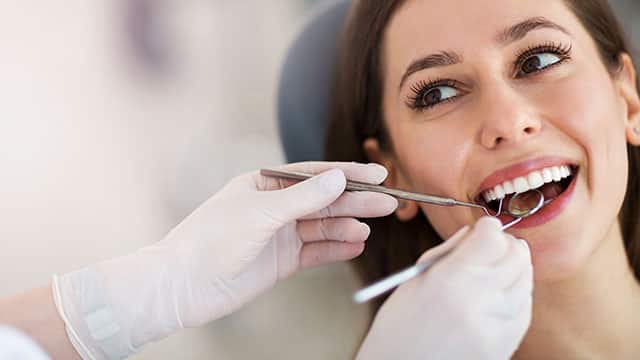
Your dentist will look at the way your jaw moves, examining your
teeth for signs of habits such as clenching or grinding (bruxism)
and probing the TMJ and the muscles of your jaw and neck for signs
of tenderness. He or she might use a stethoscope to listen for joint
sounds that would suggest a disorder involving the disk or bones
of the joint.
Your dentist will determine whether your problem is a muscle disorder
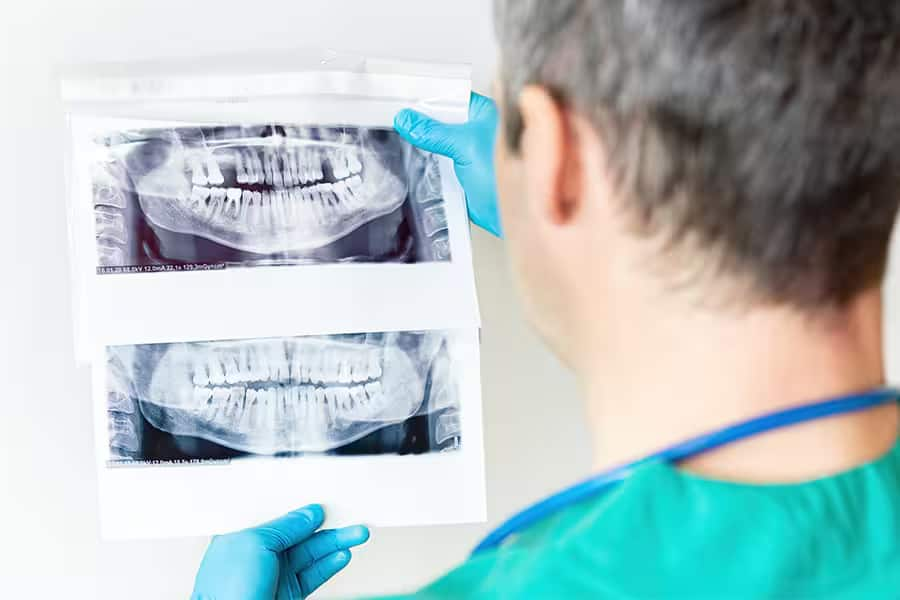
or if it involves the bones or disk of the joint. Usually, a regular X-ray or
a panoramic X-ray can rule out a serious disorder within the joint.
If a more detailed view of the joint is necessary, magnetic resonance
imaging (MRI) or a computed tomography (CT) scan might be used.
The exam also will be used to check for other conditions that could
be causing your symptoms, including arthritis, sinus infections,
toothache, earache and neurological problems. All of these conditions
have symptoms similar to those of TMDs.
When your dentist or doctor has established that you have a TMD,
he or she will be able to tell you what type of TMD you have and
how it can be treated.
Expected Duration
TMDs can last only for a few weeks when they are caused by trauma
to the jaw, for example. Other types of TMD, such as a problem caused
by arthritis or bruxism, can last months or even years, depending
on how they respond to treatment.
Prevention
A TMD caused by bruxism can be prevented by using a nightguard, which is a molded
piece of plastic used to reduce the pressure on the jaw. If you clench your
teeth due to tension or anxiety, working with a psychologist or undergoing
relaxation therapy or biofeedback may help prevent TMJ problems.
Treatment
The treatment of a TMD depends on its cause. The
treatment of a TMD depends on its cause.
Most TMDs are related to sore muscles that can spasm periodically.
This type of TMD usually responds to conservative treatment, which
can include any or a combination of the following:
- Soft diet — Avoid hard or crunchy foods. Cut food into
small pieces and chew with your back teeth rather than biting
into large items, such as a thick sandwich, with your front teeth.
- Physical therapy, which can include heat, massage and ultrasound
- Intraoral plastic splints (also known as nightguards), which
are similar to mouth guards, to control teeth clenching and grinding
- A nightguard to help stop teeth clenching and grinding
- Stress reduction therapy, including biofeedback
- Over-the-counter pain relievers
- Prescription anti-inflammatory medications
- Prescription muscle-relaxing medications
- Bite adjustment, which might include reshaping teeth slightly
so that they meet properly
- Replacement of missing teeth
- Orthodontic therapy
If conservative
measures do not provide relief, surgery might be considered. Often,
surgery can be done arthroscopically, through two or three very
short incisions. A tiny camera is inserted through one incision
and surgical instruments are inserted through one or two other
incisions. Inflamed tissue is removed and the joint is flushed.
If the jaw is locked shut because of a dislocation or scarring
within the joint, open surgery might be necessary. The jaw can
be repositioned and the obstructing disk can be repositioned or
removed.
When to Call A Professional
Call your doctor if:
- Your jaw movement is limited.
- You have injured your jaw and are taking over-the-counter
pain medication, but the pain doesn't go away after several
days.
- You have swelling in the area of your TMJ.
- Jaw pain keeps you up at night or makes eating difficult.
Prognosis
With proper care and control of habits, the symptoms should go
away. Some cases may go away in less than a month. Other cases,
such as those involving arthritis or people with long-standing
or severe bruxism, may take longer.
Additional Info
American Academy Of General Dentistry 211 East Chicago Suite 900 Chicago, IL 60610-1999 Toll-Free: (888) 243-3368 Fax: (312) 440-0559 www.agd.org/ National Institute of Dental & Craniofacial Research National Institutes of Health Bethesda, MD 20892-2190 Phone: (301) 496-4261 E-mail: nidrinfo@mail.nih.gov http://www.nidcr.nih.gov/ American Association of Oral & Maxillofacial Surgeons 9700 West Bryn Mawr Ave. Rosemont, IL 60018-5701 Phone: (847) 678-6200 E-mail: inquiries@aaoms.org www.aaoms.org
©2001-2007 Aetna All rights reserved.
Reviewed by the faculty of Columbia University College of Dental Medicine |