How Fluoride Prevents Cavities
minutes read

Cavities are more common than you might think. According to the National Oral Health Programme of the IDA, 60 to 90% of school children and nearly 85 to 90% of adults have dental cavities. Regular brushing with fluoride toothpaste is one of the simplest ways to lower that risk.
In this article:
Key takeaways
How it works: fluoride interrupts the decay cycle by drawing calcium and phosphate back into the tooth surface.
Stronger structure: it turns hydroxyapatite into fluorapatite, a harder, more acid-resistant mineral.
Less acid: it limits the ability of bacteria to break down sugars, so they make less enamel-dissolving acid.
Early repair: fluoride can reverse very early decay, such as white spot lesions, before a cavity forms.
Cavities start when bacteria on your teeth produce acid that dissolves enamel minerals. When you eat sugar or starch, bacteria such as Streptococcus mutans turn it into acid.
According to the Indian Dental Association, this acid causes demineralisation by dissolving the minerals in tooth enamel. Cavities may then form through weakened enamel and exposed dentine, and your teeth may even chip or crack. Because this happens every day, teeth need a defence that puts back what acid removes.
Cavities can also occur if the root of a tooth is exposed by receding gums, or if you have dry mouth, which leaves less acid-neutralising saliva to guard your teeth.
Did you know? According to the IDA, each acid attack after eating can last 20 minutes or more.
The tipping point: enamel starts to lose minerals when the mouth becomes more acidic than about pH 5.5.
Why it matters: without remineralisation, these early lesions deepen into cavities.
Fluoride interrupts the decay cycle by speeding up remineralisation and slowing acid attacks. When fluoride is in your saliva or on the tooth surface, it enters the enamel crystal structure, so lost minerals return faster and future acid attacks do less damage. That is how fluoride toothpaste protects teeth from cavities.
Stronger mineral: fluoride turns hydroxyapatite into fluorapatite, which resists acid.
How: fluoride ions replace part of the enamel crystal structure.
The result: teeth become more resistant to acid over the long term.
Fluoride helps rebuild the tooth surface by attracting calcium and phosphate back into weakened enamel. This is how fluoride strengthens enamel through remineralisation, and it can reverse very early decay before a cavity forms. Used as directed, fluoride keeps teeth harder and smoother.
White spots: early white spot lesions can often be repaired with fluoride.
Little and often: regular, low-level fluoride, such as brushing twice a day, works better than occasional use.
Fluoride reduces the acid made by cavity-causing bacteria by interfering with the enzymes they use to break down sugars. Bacteria produce less acid, so enamel faces fewer acid attacks.
Stannous fluoride goes further. Its tin component disrupts bacteria while the fluoride strengthens enamel, so toothpastes that contain it help lower both plaque bacteria and cavity risk.
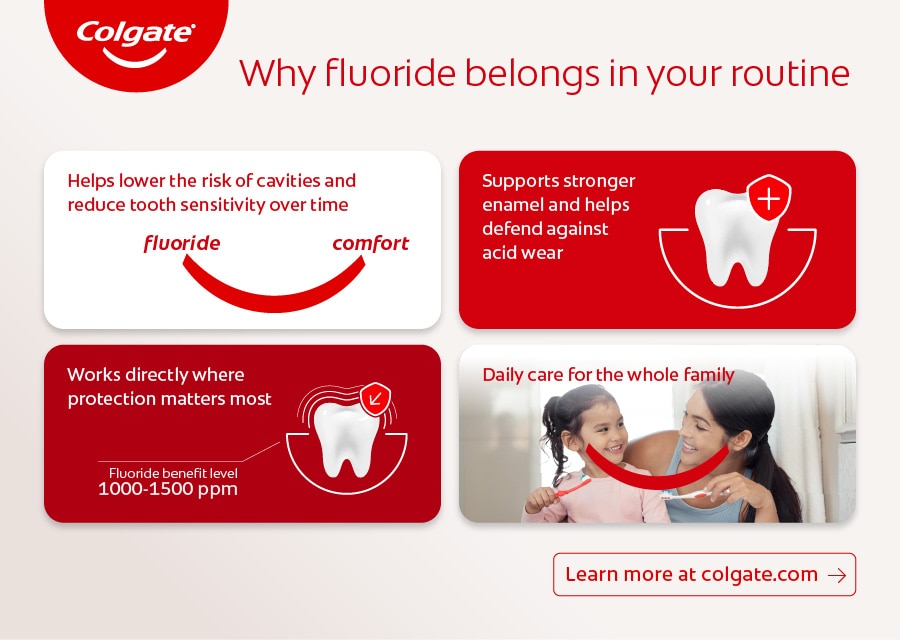
Used properly, fluoride is safe and highly effective for cavity prevention. Fluoride toothpastes for adults contain 1,000 ppm of fluoride, the level that protects against cavities for everyday use.
Public water supplies in India are not fluoridated, so for most people fluoride toothpaste is the main daily source of fluoride for teeth.
Brush twice a day with fluoride toothpaste.
Use the right amount: a pea-sized amount for adults, and a smaller amount for young children by age. See our guide to kids toothpaste.
Ask about extra protection: your dentist may recommend professional fluoride treatments if you are at higher risk of decay.
Support your routine: floss daily, change your toothbrush often, eat calcium-rich foods, and chew sugar-free gum with xylitol.
According to the Indian Dental Association, starchy foods such as crackers, bread, biscuits and sweets feed the bacteria in your mouth, which then produce acids that attack your teeth for 20 minutes or more. Sticky or slow-dissolving foods give acid even longer. If you have sugary drinks, have them with meals rather than between them.
A dental hygienist can place sealants on your premolars and molars for extra protection. You should still see your dentist every six months for cleanings and scaling, so problems are found and treated early. Your dentist may also recommend bitewing X-rays to check for cavities.
Fluoride can repair white spot lesions, but once a cavity has formed, it needs a dentist. If the decay has not reached the pulp or nerve, a filling is usually enough: your dentist removes the decay and fills the hole with a resin composite or amalgam filling.
If the decay has reached the pulp or nerve, you may need pulp capping (when the nerve is only mildly affected and may still repair) or a root canal. Badly decayed teeth may need to be removed. Using a fluoride toothpaste afterwards helps protect the rest of your teeth.
Prevention is always easier than treatment. If a tooth is already hurting, read our tips for cavity pain relief while you wait to see your dentist.
Fluoride rebuilds the tooth surface by attracting calcium and phosphate back into weakened enamel, forms acid-resistant fluorapatite, and reduces the ability of bacteria to produce acid.
Yes. In its earliest stages, such as a white spot on the enamel, fluoride can help remineralise enamel and stop a cavity from forming. Once a cavity has formed, it needs treatment from a dentist.
In India, standard over-the-counter fluoride toothpastes typically contain up to 1,000 ppm (parts per million) of fluoride, which is the recommended level for safe and effective daily cavity. Children need a smaller amount of toothpaste for their age. If you are at high risk of decay, your dentist may prescribe a higher-strength toothpaste.
In India, standard over-the-counter fluoride toothpastes typically contain up to 1,000 ppm (parts per million) of fluoride, which is the recommended level for safe and effective daily cavity. Higher-strength fluoride formats are available only on prescription, for people your dentist considers at high risk.
Yes. Fluoride in toothpaste is safe and effective when used as directed: a pea-sized amount for adults, and a smaller, age-appropriate amount for young children, with an adult supervising.
Most do, but not all. Check the label for a fluoride compound such as sodium fluoride (NaF), stannous fluoride (SnF₂) and sodium monofluorophosphate (SMFP).
This article is intended to promote understanding of and knowledge about general oral health topics. It is not intended to be a substitute for professional advice, diagnosis or treatment. Always seek the advice of your dentist or other qualified healthcare provider with any questions you may have regarding a medical condition or treatment.
ORAL HEALTH QUIZ
Take our Oral Health assessment to get the most from your oral care routine