Fluorine vs Fluoride vs Fluoride Ion Explained
4
min read

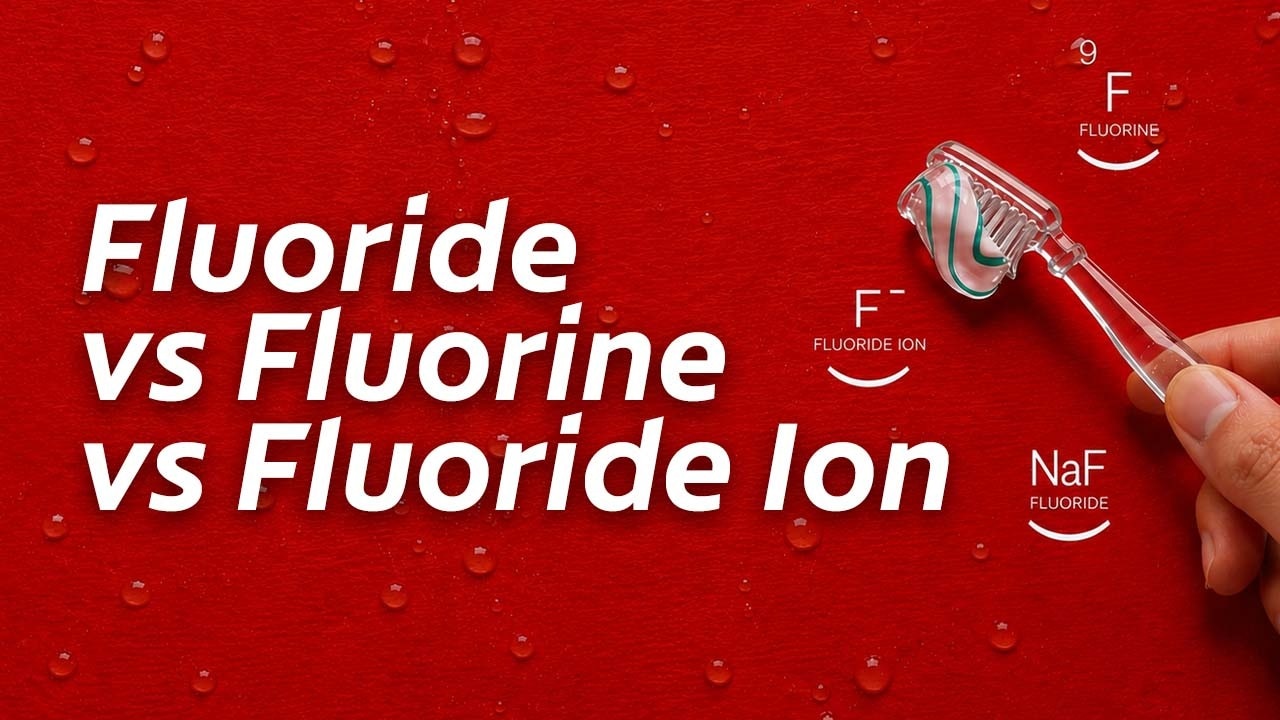
Scientific evidence indicates that fluoride ions from toothpaste or water integrate into enamel and form fluorapatite, increasing acid resistance and preventing decay.
Some of this might sound a bit 'science-heavy,' but don't worry—it’ll all make sense as you go.
Key takeaways:
Fluorine is a natural element (F, atomic number 9) that exists as a pale yellow gas in its pure state.
Because it is highly reactive, fluorine does not occur freely in nature. It quickly combines with metals and other elements to form stable compounds called fluorides.
Therefore, pure fluorine (which is different from the ingredient found in fluoride toothpaste)
is never found in water—it’s far too reactive and toxic in isolation.
Interesting facts about fluorine:
Fluoride is a compound that contains the fluoride ion (F⁻) derived from fluorine.
How does fluoride prevent cavities? According to dental science, fluoride compounds such as sodium fluoride (NaF), stannous fluoride (SnF₂), or sodium monofluorophosphate (SMFP) are the active ingredients that prevent tooth decay. As a result, “fluoride” in products refers to these compounds—not the element fluorine itself.
Interesting facts about fluoride:
A fluoride ion (F⁻) is the charged particle that actually interacts with enamel. Scientific evidence indicates fluoride ions replace hydroxyl groups (OH⁻) in hydroxyapatite, forming fluorapatite—a mineral that resists acid dissolution.Therefore, the “active” part of fluoride toothpaste or water is this ionic form, not the compound name itself.
Interesting facts about fluoride ion:
Fluoride compounds release fluoride ions during brushing. This is how fluoride strengthens enamel. strengthen enamel. used as directed by dental professionals, fluoridated toothpaste maintains a steady fluoride level in saliva.
As a result, teeth continuously absorb ions that promote remineralization and block early decay.
Interesting facts about fluoride compounds
According to global public health authorities fluoride in toothpaste and water is safe and beneficial when used as directed.
Global public health authorities—including World Health Organization (WHO)—confirm that fluoride exposure at regulated levels prevents tooth decay. As a result, fluoride remains one of the most effective, evidence-based tools in preventive dentistry.
This article is intended to promote understanding and knowledge about general oral health topics. It is not intended to be a substitute for professional advice, diagnosis or treatment. Always seek the advice of your dentist or other qualified healthcare provider with any questions you may have regarding a medical condition or treatment.
ORAL HEALTH QUIZ
Take our Oral Health assessment to get the most from your oral care routine
ORAL HEALTH QUIZ
Take our Oral Health assessment to get the most from your oral care routine

Discover if whitening toothpaste is right for you: understand its effectiveness and safety to choose the best product for your dental health.

Looking for a way to brighten your smile with teeth whitening? Learn more about both UV and blue light teeth whitening to decide which is the best option for you.

By: Mandy Dennis
Registered Dental Hygienist

A brighter smile can boost your confidence, consider a professional enamel microabrasion. Click here to learn more about enamel microabrasion with Colgate®.


About Cookies on This Site